How to play
Push high-scoring pieces off the board and into your treasure chest. For 2 to 4 players.
What you have
- A chessboard, 8 squares by 8, empty at the start.
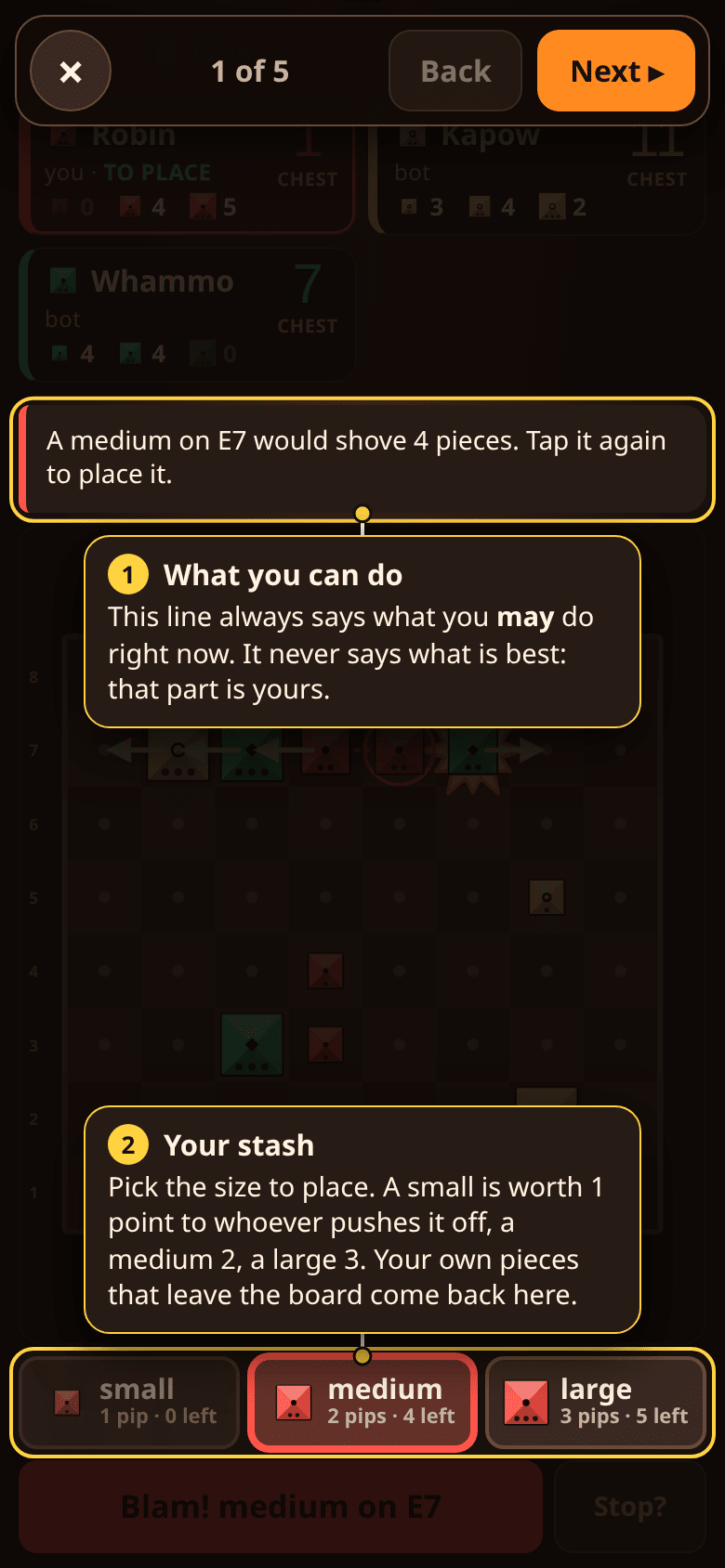
- A stash of 15 pyramids in your own colour: 5 small, 5 medium and 5 large. A piece is worth its pips: 1, 2 or 3 points.
- A treasure chest, also empty at the start.
Your turn
- Place one piece from your stash on any empty square.
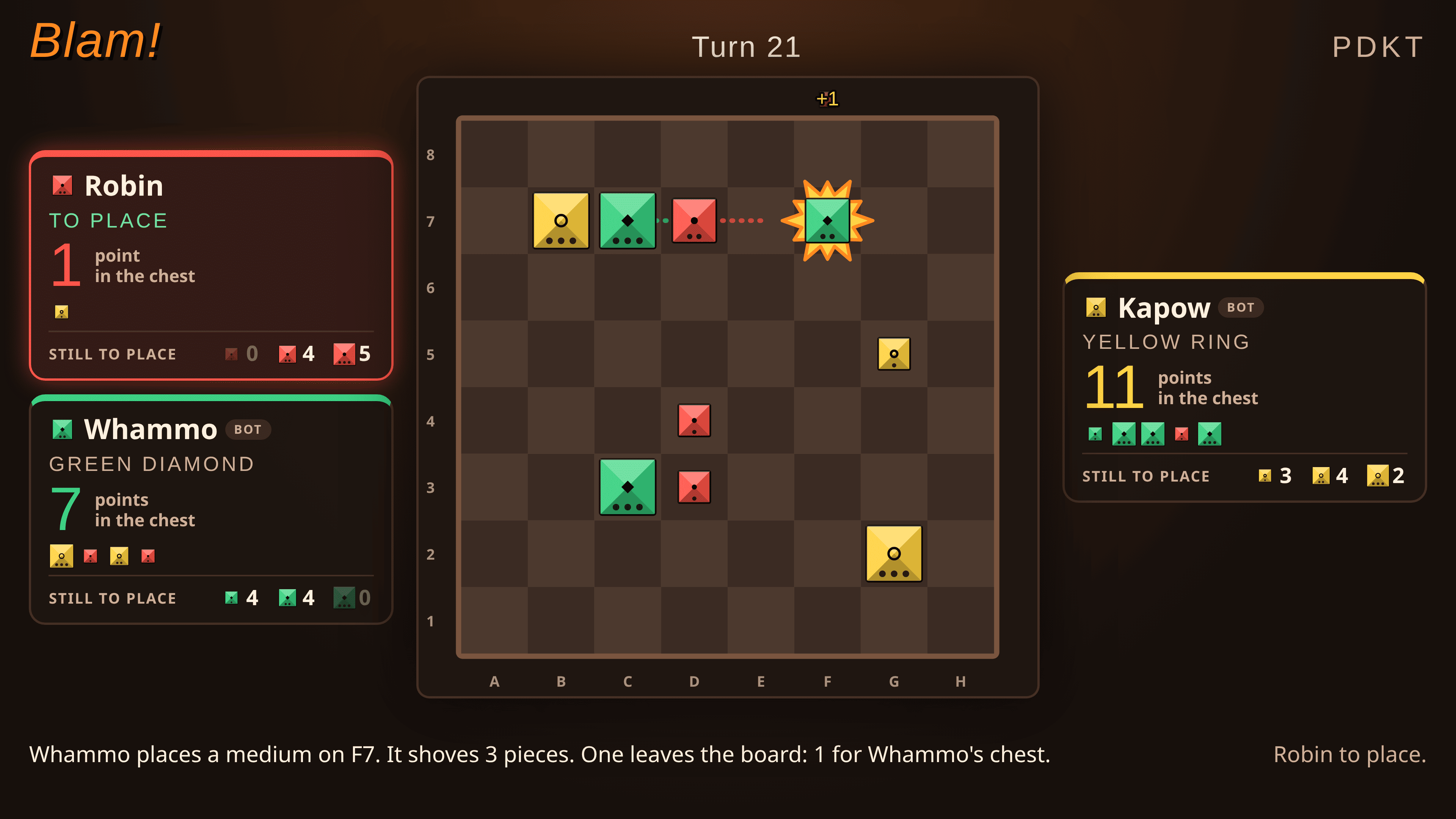
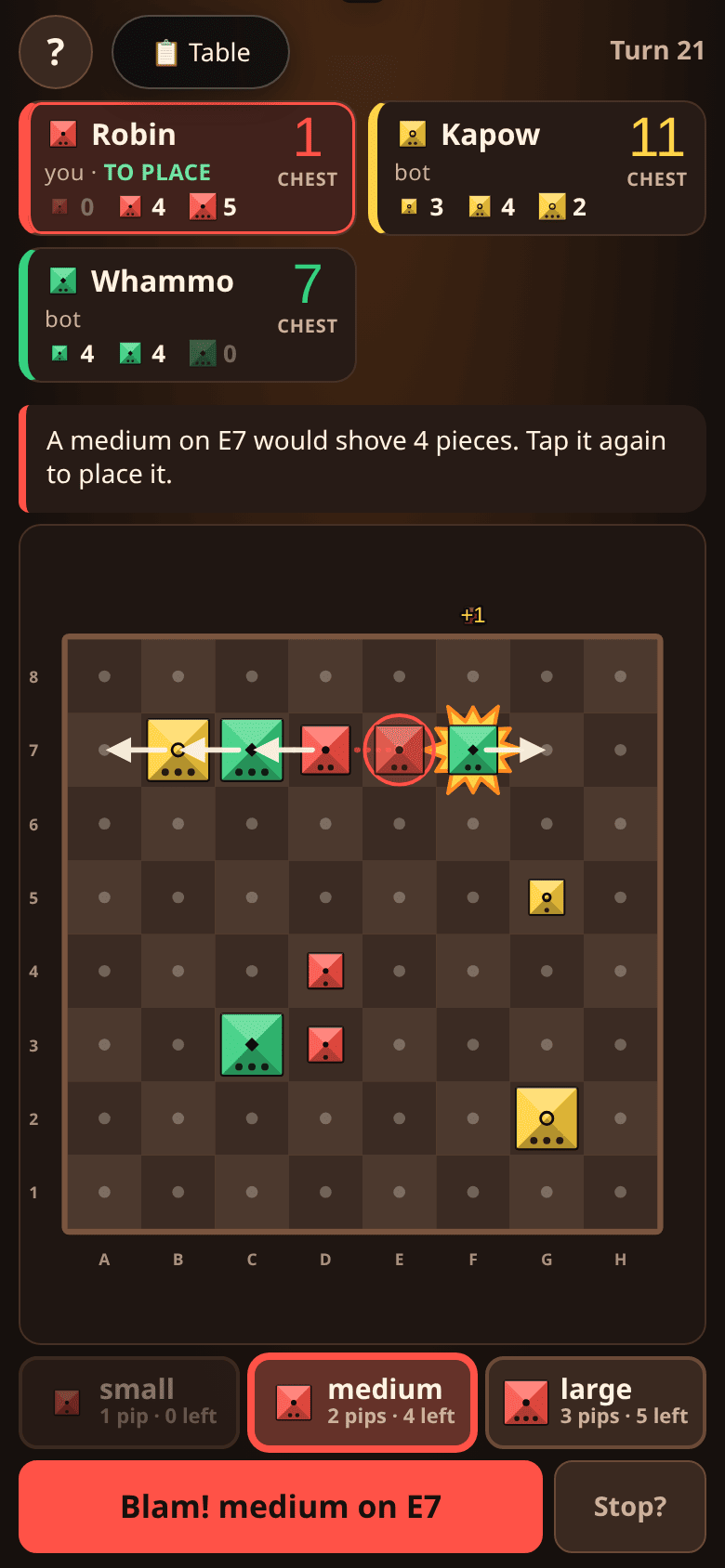
- Every piece in a square next to it, diagonals included, moves one space directly away from the piece you placed. It does not matter whose pieces they are.
- If a moving piece runs into another piece, it pushes that one into the space beyond, and so on. A whole row can move.
- A piece pushed off the board goes into your treasure chest. If it is your own colour, it goes back into your stash instead.
- Then the turn passes to the next player round the table who still has a piece to place.
The end
- The game ends when every stash is empty. A player whose stash is empty is passed over while the others finish.
- It also ends when everyone agrees to stop: each person taps Stop? and confirms. Bots go along with the people at the table.
- Add up the pips in your treasure chest and in your stash. The highest total wins, and equal totals share the win. Pieces still on the board score for nobody.
Overloaded
- A variant from the rules page, set in the lobby before the game. A large piece pushes its neighbours three spaces, a medium two, a small one.
- The push is taken one space at a time, so a piece pushed three spaces shoves whatever it runs into along the way.
Good to know
- Red, yellow, green and blue each carry their own mark on the tip of the pyramid as well: a dot, a ring, a diamond and a cross.
- The pieces in your stash only score if the game is stopped early. Played to the end, your score is your chest.
- A placement cannot be taken back: it hands the turn over at once. Aim first, then place.
- Bots can take the empty seats. They play by the same rules through the same door, and see what a player sees.
- If your phone sleeps, your seat waits. A bot covers a turn only after five minutes, with a clock on screen first, and one tap takes the seat back.
Blam! is by Jon Eargle, published by Invisible City Productions (2005), with thanks on the original page to the Monday Night Games group for playtesting and to Sharon for editing. The page also mentions Blam! Online, by Aaron Dalton. The original rules: invisible-city.com/content/blam.